
This is part of our series on upcycling coffee by-products.
Table of Contents
i. Introduction
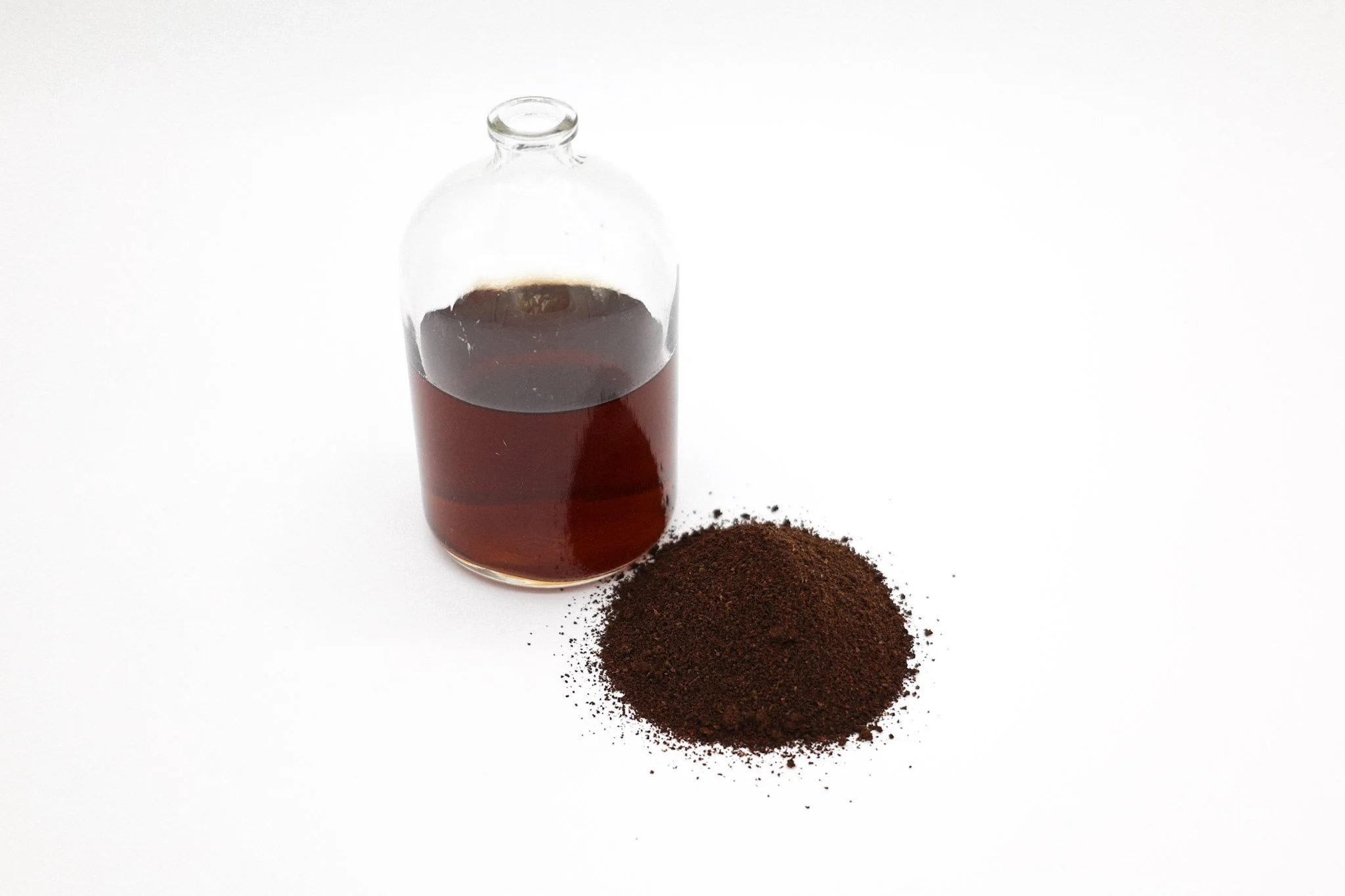
Previously, we used finely milled spent coffee grounds to make a miso. Here, we adapt that technique to create a shōyu, an umami-rich liquid condiment whose original form is a type of soy sauce. Together, these recipes show how, in the pursuit of umamification, the same by-product can be upcycled into distinct, flavourful condiments, each suitable for different applications.
ii. Recipe
Ingredients
1 part spent coffee grounds, dried
5 parts boiled water, weight measured after boiling
1.5 parts barley kōji, frozen or fresh
3 parts fresh water
salt, 4% by mass of previous ingredients
Method
Place the spent coffee grounds in a large heatproof bowl and pour over just-boiled water.¹ Allow the mixture to cool to below 40°C.
Transfer the mixture to a wet mill, such as a Premier Wonder Mill or similar, and mill for 24 hours.
Transfer the coffee purée into a large sterilised bowl.
Blend the barley kōji, remaining water and salt together in a high-speed blender. Add the kōji–brine mixture to the bowl with the coffee purée and combine.²
Sterilise a large fermentation vessel using alcohol or boiling water. Allow to evaporate if the former, and to cool if the latter. Carefully pour in the shōyu mixture. Place a sheet of plastic wrap on top of the mixture in direct contact with its surface, then cover loosely with aluminium foil, dry muslin cloth secured with an elastic band, or a loose lid, to allow gas exchange while preventing contamination.
Stir the mixture daily, for two weeks, to evenly distribute the solids and liquids and to prevent a biofilm from forming on the surface. After two weeks, stirring can be done weekly. This can be done using a sterilised utensil, or by temporarily removing any loose coverings, sealing the jar with a tight-fitting lid and gently shaking it. Re-cover after mixing.
Ferment the shōyu at ambient temperature, out of direct sunlight, for 6-12 months.
Once fermentation is complete, strain the mixture to separate solids and liquids, either through fine muslin cloth or using a centrifuge. Retain the liquid. The shōyu can be refrigerated for up to 1 month or frozen for longer storage. Refrigeration and freezing slow down but do not completely stop the microbial and enzymatic activity. A shelf-stable product can be achieved in different ways: we chose to seal the shōyu in an airtight jar or vacuum bag and heat it in a water bath or steam at 90°C for 40 minutes to denature enzymes and arrest further activity.³
iii. Adaptations
We made this recipe with spent coffee grounds from our office coffee machines. It could be interesting to make it with the spent grounds of different types of coffee beans to compare the flavours. We suspect it’ll be delicious whether you make it with single-origin speciality coffee or cheap coffee, as we did for our coffee miso.
Since the final product is a liquid, you can use fresh coffee grounds instead of dried ones without worrying too much about overhydrating the mixture, which can be an issue with a miso. If you do use fresh grounds, you should adjust the added water to account for their higher moisture content so the total hydration stays roughly the same.
An accelerated process can be achieved by incubating the shōyu mixture at 60°C for 1-3 months. Note that acceleration may result in reduced microbial complexity and a less robust flavour, but will still yield an umami-rich product.
Contributions & acknowledgements
Kim performed the original culinary R&D starting in 2015, developing it further with us. Nurdin tested the recipe and documented the process with notes and photography. Eliot wrote the article using these notes and following further discussion with Nurdin and Kim, with contributions and editorial feedback from Josh. Nurdin and Eliot photographed the final product in our food lab.
Thanks to Thilde Leicht Madsen and the operations team at DTU Biosustain for providing us with the spent coffee grounds from our office coffee machines.
This recipe has roots in Kim’s previous work as Head of R&D at the former Amass Restaurant in Copenhagen. Thank you Amass for facilitating such trailblazing work in culinary upcycling and holistic sustainability!
Related posts

Endnotes
[1] The water must be boiled and poured over the dehydrated spent coffee grounds before grinding to kill off any residual microbes so that the mixture doesn’t begin to spontaneously ferment in the grinder.
[2] When we milled 2500g of coffee and water together (417g coffee and 2083g water, the maximum volume that would fit in our wet mill), about 300g of water, or 12% of the total mass of the coffee-water mixture, was lost to evaporation. The ‘parts’ measurement indicated in the ingredients list refers to the pre-milling weights, not post-milling with evaporation.
[3] You can use a different, more precise pasteurisation method (e.g. 72˚C internal temp for 15 seconds) if you have access to specialist equipment and prefer to do so.