
Kōji'd lemon skin shōyu
This is part of our series on upcycling fruit & veg by-products.
Table of Contents
i. Introduction
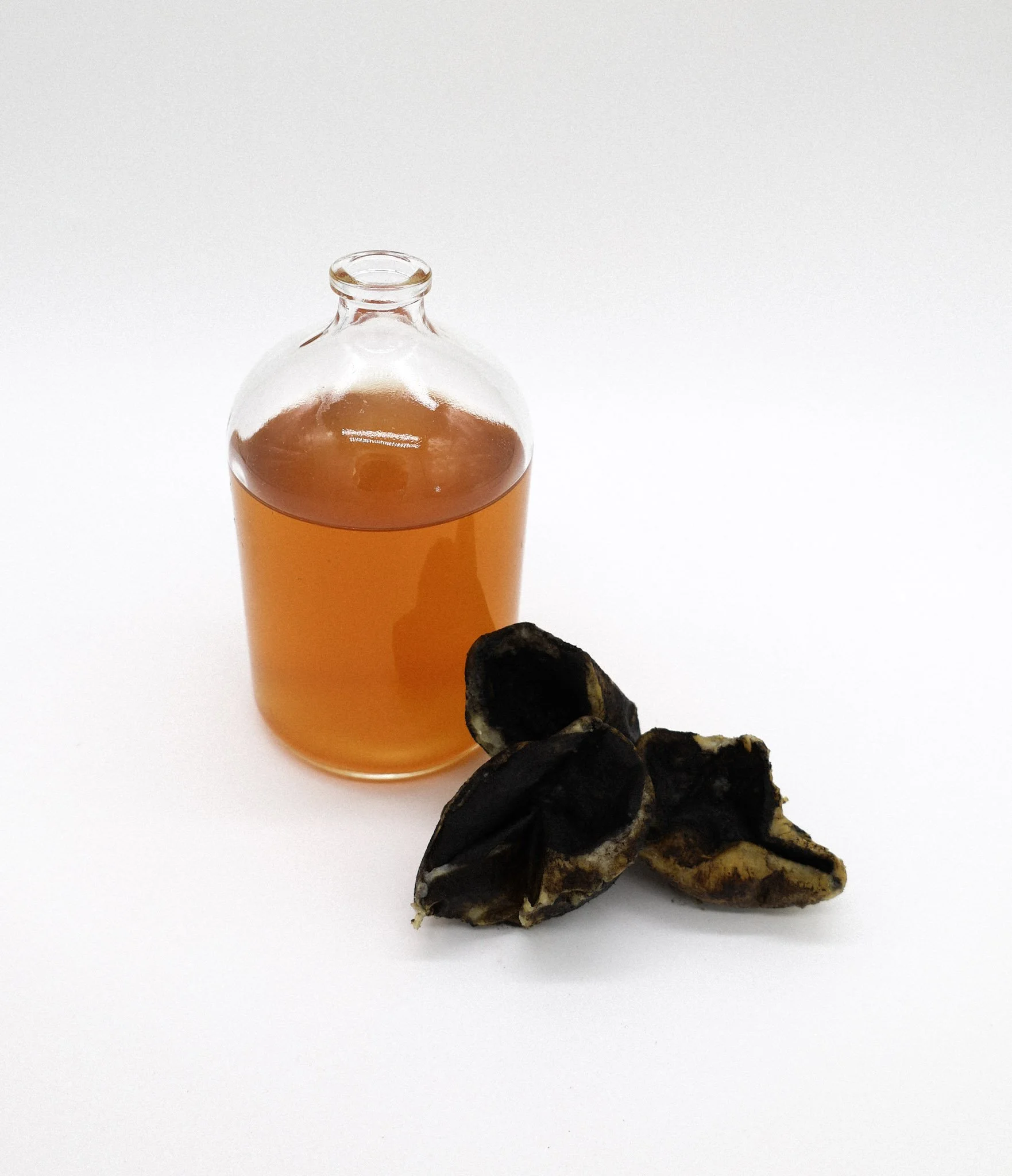
This shōyu uses our kōji’d lemon skin base recipe, where we grow Aspergillus luchuensis on juiced lemon skins to re-acidify them. Here we combine those lemon skins with the more familiar Aspergillus oryzae barley kōji and other ingredients to make an umami-rich shōyu with a bright citrus acidity and the sunshine taste of the lemon.
ii. Recipe
Ingredients
200g kōji’d lemon skin¹
100g barley, soaked in 200g water overnight
500g barley kōji, frozen or fresh
1800g water
200g salt, or 8% by mass of previous ingredients
Method
Strain the soaked barley and transfer it to a perforated steaming tray. Steam it in a preheated Rational oven on full steam and fan speed 4 for 40 minutes. Remove from the oven and allow to cool to 35°C.
Mash the freshly steamed barley, kōji’d lemon skin and barley kōji together in a large sterilised bowl. Stir in the water and salt, then blend thoroughly using a hand mixer until well combined.
Sterilise a large fermentation jar using alcohol or boiling water, and if the latter allowing it to cool. Carefully pour in the shōyu mixture. Place a sheet of plastic wrap on top of the mixture in direct contact with its surface, then cover loosely with aluminium foil, dry muslin cloth secured with an elastic band or a loose lid, to allow gas exchange while preventing contamination.
Stir the mixture daily, for two weeks, to evenly distribute the solids and liquids and to prevent a biofilm from forming on the surface. After two weeks, stirring can be done weekly. This can be done using a sterilised utensil, or by temporarily removing any loose coverings, sealing the jar with a tight-fitting lid and gently shaking it. Re-cover after mixing.
Ferment the shōyu at ambient temperature, out of direct sunlight, for 6-12 months.
Once fermentation is complete, strain the mixture to separate solids and liquids, either through fine muslin cloth or using a centrifuge. Retain the liquid.
The shōyu can be refrigerated for up to 1 month or frozen for longer storage. Refrigeration and freezing slow down but do not completely stop the microbial and enzymatic activity. For a shelf-stable product, seal the shōyu in an airtight jar or vacuum bag and heat in a water bath or steam at 90°C for 40 minutes to denature enzymes and arrest further activity.²
iii. Adaptations
An accelerated process can be achieved by incubating the shōyu mixture at 60°C for 3-6 months. For this process, you can reduce the salt to 4% by mass of other ingredients instead of 8%. Note that acceleration may result in reduced microbial complexity and a less robust flavour, but will still yield an umami-rich product.
If a clear end product is desired, the liquid can be ice-clarified between steps 6 and 7.
Contributions & acknowledgements
Kim performed the original culinary R&D starting in 2016, developing it further with us. Nurdin tested the recipe and documented the process with notes and photography. Eliot wrote the article using these notes and following further discussion with Nurdin and Kim, with contributions and editorial feedback from Josh. Nurdin and Eliot photographed the final product in our food lab.
This recipe has roots in Kim’s previous work as Head of R&D at the former Amass Restaurant in Copenhagen. Thank you Amass for facilitating such trailblazing work in culinary upcycling and holistic sustainability!
Related posts

Endnotes
[1] We used a black spore strain of A. luchuensis for this shōyu. It would work just as well with a white spore strain but will have a lighter colour.
[2] You can use a different, more precise pasteurisation method (e.g. 72˚C internal temp for 15 seconds) if you have access to specialist equipment and prefer to do so.