
Juice presscake ‘marzipan’ & kransekager
This is part of our series on upcycling fruit & veg by-products.
Table of Contents
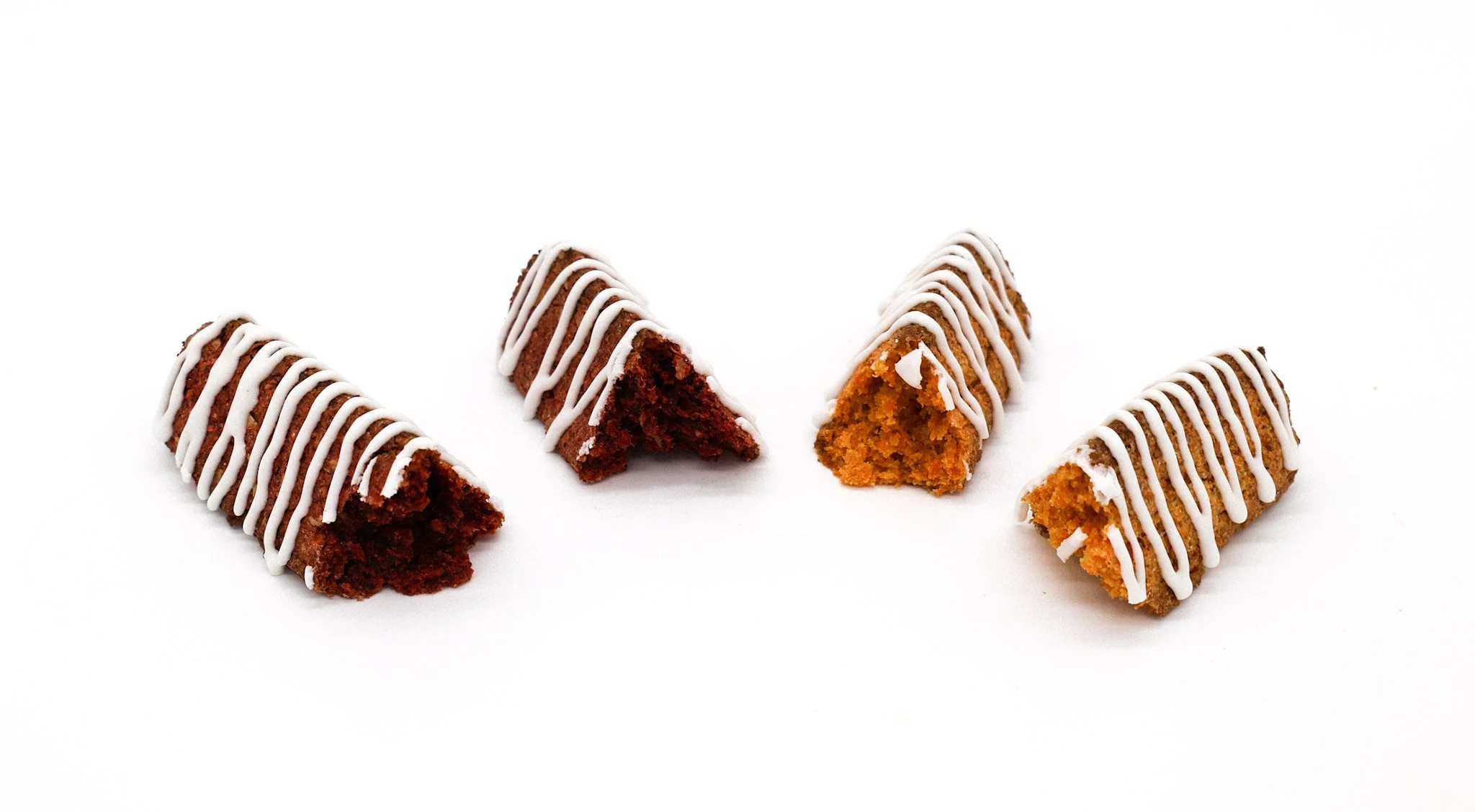
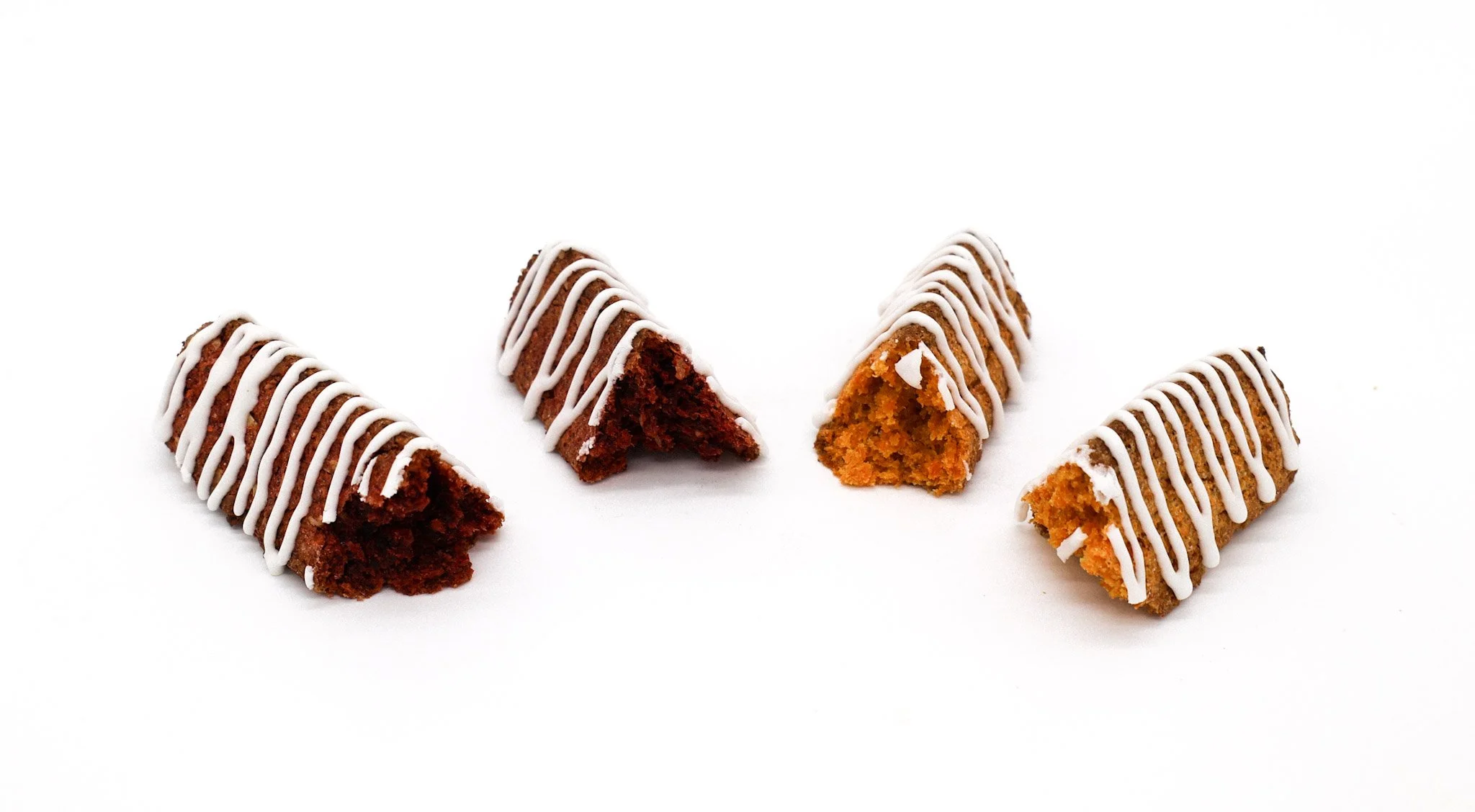
Kransekager made with beetroot and apple presscake ‘marzipan’ (left) and carrot presscake ‘marzipan’ (right)
i. Introduction
Whilst our culinary R&D often focuses on foods with transformative potential, like those oriented toward plant-based umamification, sometimes it’s also simply about having fun.¹ With this in mind, we made something for the fast-approaching winter holidays.
After previously experimenting (to great success) with making marzipan using almond milk presscake instead of almond flour, Kim wondered if a similar process might work with other types of presscake. He found that juice presscake ended up working particularly well, processing it with sugar and egg to make a flavoured ‘marzipan’ of sorts that is both familiar and its own thing. We experimented with a couple different juice presscakes—beetroot and apple, and carrot, both of which made delicious, strikingly coloured ‘marzipans’.
We then used these ‘marzipans’ to make kransekager, traditional celebratory Danish baked goods typically enjoyed at New Year’s, weddings, and other special occasions. Sometimes served as grandiose towers of concentric rings which one breaks pieces off of by hand, they’re also often made into smaller individual biscuit-like servings, as we did here. The beetroot and apple presscake kransekage was our favourite as it was a bit more complex: sweet, but rounded and a little earthy. The carrot presscake version also worked well and was popular with the Danes among us who tasted it, perhaps because it was closer in flavour to a traditional kransekage. It might shine even more with a companion flavour like coffee, citrus, or Christmas spices. Either way, both were delicious and hinted that there’s plenty more potential in the world of juice presscakes yet to be uncovered.
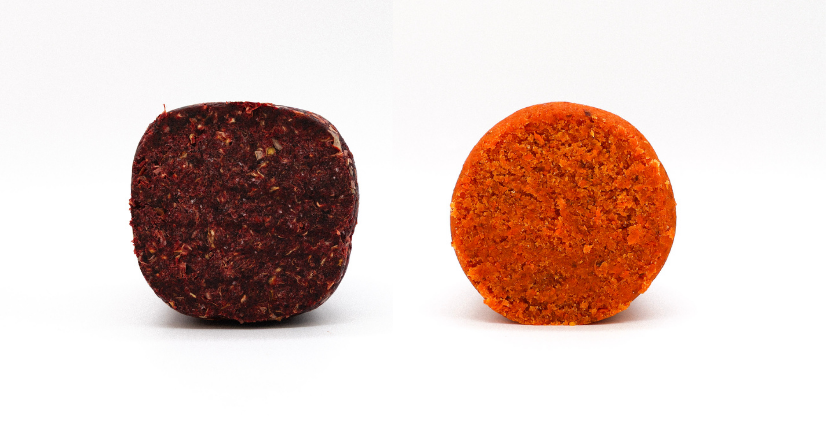
‘Marzipan’ made with beetroot and apple presscake (left) and carrot presscake (right)
ii. Recipe
a. Juice presscake ‘marzipan’
Ingredients
300g juice presscake
300g icing sugar
9g egg white powder
60g coconut oil, de-flavoured²
Method
Spread the juice presscake evenly over two oven trays lined with silicone mats, forming a uniform layer about 1 cm thick.
Dry roast for 20 minutes in a preheated Rational oven at 160 °C, 0% humidity, then remove from the oven and allow to cool.
Add the roasted juice presscake, icing sugar and egg white powder to the bowl of a food processor, and process on full power for 4-5 minutes. The residual moisture in the presscake will rehydrate the egg white powder, and the heat generated during mixing will melt the sugar, binding the mixture into a marzipan-like paste.
Roll the solid mixture into a thick cylinder, wrap tightly in cling film or baking paper, and refrigerate for at least 2 hours before use. Alternatively, freeze until required.
b. Juice presscake kransekager
Method
Whisk 30g of the egg white to soft peaks, then gradually add the caster sugar, whisking until fully incorporated.
Break the juice presscake ‘marzipan’ (a) into small pieces in a large bowl. Add the meringue mixture and stir until a uniform moist paste forms. Cover and refrigerate for at least 1 hour.
Divide the paste into 35g portions and roll each into a cylinder shape, or pipe into 8cm lengths (about 2cm diameter) onto a silicone mat or greaseproof paper. Then shape each cylinder into a triangular prism using a small offset palette knife, bench scraper or your fingers. Place each onto a silicone mat or an oven tray lined with greaseproof paper.
Bake in a preheated Rational oven at 190°C at 0% humidity on full fan for 8-10 minutes. Remove from the oven and allow to cool.
For the icing, mix the powdered sugar with the remaining 30g of egg white until smooth. Transfer to a small piping bag, cut with a 2mm opening. Pipe the icing over the cooled biscuits in a zigzag pattern.
Ingredients
250g juice presscake ‘marzipan’ (a)
60g fresh egg white
60g caster sugar
150g powdered sugar
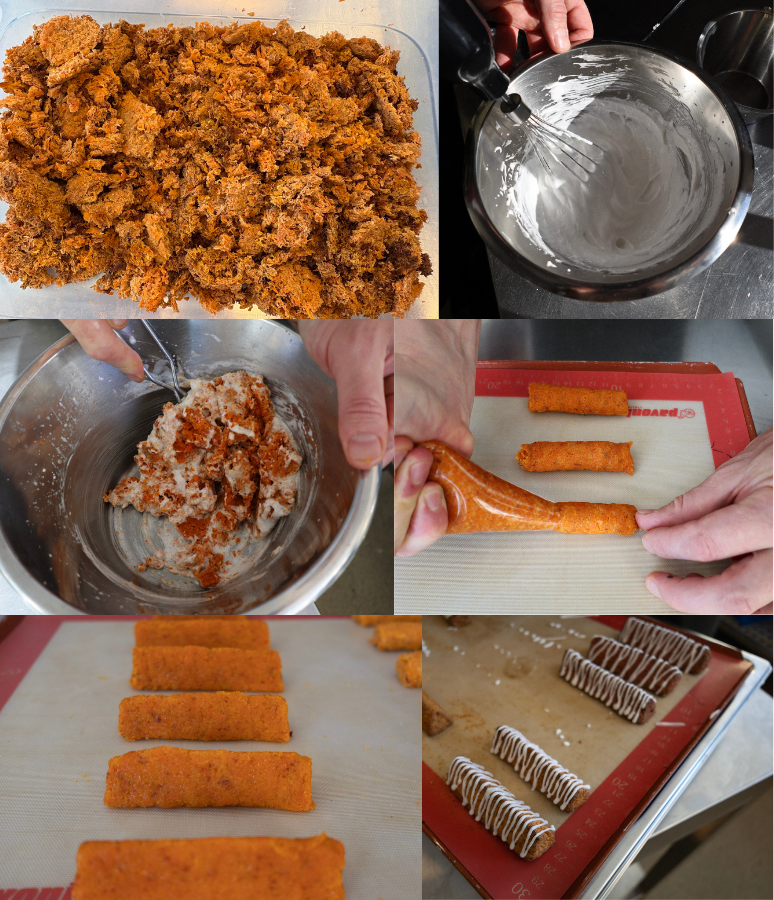
Making carrot presscake kransekager
iii. Adaptations
This base recipe can be adapted in all sorts of ways to produce diverse ‘marzipans’. You could try making it with any kind of juice presscake, or even different presscakes like plant milk presscake; substitute neutral coconut oil for different flavoured oils or the icing sugar for a different kind of sugar; or add additional complementary flavourings, or even other ingredients like nuts if you desire. If you want something slightly more traditionally ‘marzipan’-flavoured, you could add some almond flour too.
Whatever type of ‘marzipan’ you end up making could then be used to make kransekager, any other recipes that use traditional marzipan as an ingredient, or even in different confectioneries that don’t usually contain traditional marzipan at all.
Contributions & acknowledgements
Kim performed the original culinary research, with further testing and R&D conducted by Nurdin and Eliot, who documented the process with notes and photography. Eliot wrote the article using these notes and following further discussion with Nurdin and Kim, with contributions and editorial feedback from Josh. Nurdin and Eliot photographed the final product in our food lab.
Related posts
Endnotes
[1] Since almonds are famously water-thirsty in some contexts, substituting almond flour for juice presscake is actually a great way of making lower-impact confectionary. We’re not suggesting all almonds should be replaced by upcycled alternatives, but turning juice presscake into a marzipan-like product is a great way of using something that would otherwise be thrown out.
[2] Ground almonds are about 50% fat by mass, so we have added a non-scented coconut oil to help achieve marzipan’s characteristic richness and texture, and provide a non-greasy mouthfeel.